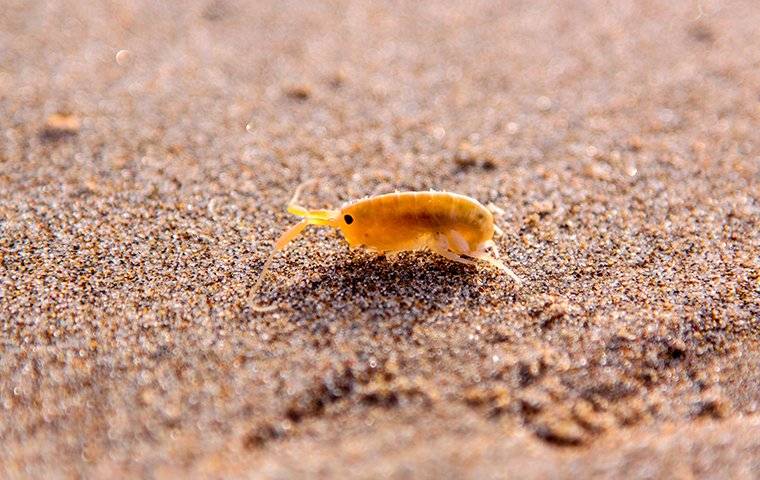
Amphipods are usually ¼ to 1-inch long. Most of the time, they appear dark brown or black, but may appear red, pink, yellow, green or blue, depending on the species. After death, their dry bodies often turn bright red. Amphipods are commonly referred to as scuds and inhabit most of the oceans, lakes, rivers, beaches, caves, and other hot and humid environments. They are compressed laterally or flattened and look like small shrimp.
These crustaceans are important members of the food chain, serving as food for many fish, invertebrates, shorebirds and other animals. They are also important as scavengers and detritus. Drought, excessive rainfall and prolonged irrigation of the gardens can cause amphipods to seek better living conditions, taking them to a home or building.
Habitat
Amphipods in Charlotte can be found in the highly moist forest litter or any other dense earth cover where they can sink into the upper inches of the ground. They are commonly found living under ivy that is used as a ground cover. There are several types of amphipods on the west coast of North America.
Most investigations, apart from scientific classification/transport, have been carried out on a pair of intertidal and supratidal/semi-terrestrial species and these revisions will be highlighted in ODYSSEY. These species are grouped within the family Talitridae. How many types are there of amphipods? There are no less than 120 completely terrestrial types of landowners, commonly called “landhoppers”, occupying forests from the ground to cover, soils, plants, hollows, meadows and mountains, but they occur in the tropical and subtropical zones of the southern hemisphere.
The dependence of water on terrestrial species is reduced to that which is accessible in the fall of dew and in sustenance. The transformative achievement of amphipods in colonization of land among shellfish is the second for Oniscidian Isopods. Just as in the Oniscidians, much of this colonizing achievement is due to elements believed to be available in tribal Intertidal species.
There are 2 normal species of Megalorchestia in California that also possess sandy coastlines, involve tunnels near the filament line, and eat similar types of ocean growth nourishments. In any case, the Hopkin Marina Station, Pacific Grove fellows demonstrate that their disseminations rarely cover attributable to the inclinations of the different types of coasts.
Find out more about the pests in your area, including how to identify them, how to exterminate them, and some helpful prevention tips for each pest. The most common pests found in our area include ants, mosquitoes, termites, rodents, cockroaches, bed bugs, and spiders.
Invasion of amphipods in the indoors occurs when the conditions support a large number of these crustaceans. Treatments can provide short-term relief, but correcting such conditions is key to long-term success. Altering or eliminating excess moisture conditions next to a building can be useful, particularly when dealing with landscape and lawn watering, as well as steering drainage problems. Thick soil covers such as ivy, “monkey” grass, etc.
It should not be located next to or near a foundation as they provide harborage for innumerable insects, spiders, mice and other rodents. Items in contact with the floor should be removed whenever possible. External cracks and holes should be sealed, especially along the foundation. The drip holes can be “closed” by filling pieces of wire mesh or screening in the openings.
Very kind and helped resolve a billing issue for us right away!
“He did the job quickly and I’m looking forward to seeing the results!”
- Asher W.
He took the time to talk to me about the products and how they are used.
“We appreciate him and go-forth and will definitely recommend services.”
- Crystal B.
Lovely interaction with the booking agent as well!
“He was professional, kind and we have every confidence he will take great care to protect our farm.”
- Nikki H.
He was courteous, friendly, and efficient at his job.
“The overall visit was great and I would recommend Go-Forth Pest to others.”
- Susan C.
The subscription is definitely affordable and well worth it!!
“Any further issue or findings he had, he was forthcoming with any helpful information.”
- Brittney Y.
Garrett was professional and helpful.
“He spent time educating us about "pests" and provided information regarding services with GoForth.”
- Joyce C.
This was my first experience with this co. They were very easy to get along with.
“Texted me before coming. Worked with me playing musical rooms with my dogs. I'll see how things are.”
- Constance E.
I'm very grateful that I found this company today!
“Amazing response time, reasonable prices, great customer service. Tevin was thorough and confident in his plan to fix our horrendous fire ant problem. We have had negative experiences with prior exterminators and probably waited way too long to call Go-For”
- Ashley T.
Great service with excellent solutions for any of our needs.
“We have been customers for almost 7 years for a reason. Our technician is the best. He always knows exactly how to address whatever pest has decided to bother us. We have referred them to many of our neighbors. Well worth the cost not to have to worry abou”