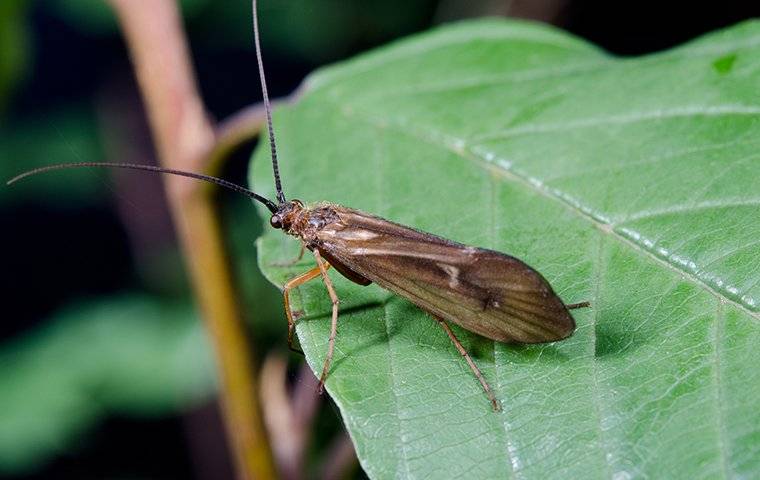
The caddis fly varies in size from 1/16 inch to 1 inch in length, depending on the species, and its color ranges from brown to black. Caddisflies are slender, elongated insects with furry, almost moth-like wings that they hold tent-like on the abdomen. They have long antennae, wire type, attached to their heads.
Caddisflies in High Point are important insects in freshwater ecosystems, where they reproduce in streams, ponds, and lakes, serving as food for a wide variety of aquatic animals, especially fish. Adults of a particular species emerge from the water at about the same time, sometimes forming clouds of insects over the water. These adults are strongly attracted to lights on buildings located near waterways, thus becoming “plagues” at times.
Most commonly, one or two adult caddis flies will accidentally fly into a home where the owner might become worried. Grown-ups live for around one month and feast upon nectar consumed by basic mouthparts. Female caddis flies lay masses of eggs on vegetation over the water’s surface. When the hatchlings are shown in the eggs, they fall into the water and quickly begin to assemble defensive cases.
At the point when the hatching is completely developed, it enters the pupal stage. The hatching appends the case to some strong protest, as like stone or a bigger bit of submerged wood, and seals the opening. In this way makes the casing of silk around the body. Pupal cases can be punctured and in this manner water porous. In addition, creepy crawlies experiencing change inside the case undulated, with a specific end goal to make a stream of oxygenated water around the body.
Combine of sectioned legs reaches out from each thoracic portion. Legs can have adjustments like sharp endings, snares, or columns of setae. Their motivation is to help the hatchlings in development, fabricating the sanctuary, or gathering nourishment. They are utilized to grapple the hatchlings for the situation. Their eyes are little and straightforward. Receiving wires are little and can be seen just under high magnification.
Constantly submerged stones and bits of wood give the best substrate to the development of green growth and periphyton, which the hatchlings successfully scrap. As they brush, caddis fly hatchlings may expend a noteworthy part of the accessible green growth in the stream. A few animal groups with extensive mouth parts shred leaves of earthbound plants fallen into the water.
Caddis fly hatchlings acquire oxygen which is broken up in water through thin and delicate skin. A few animal groups have spread gills or protuberances on the sides of the body (with a specific end goal to build the body surface). Hatchlings undulate their bodies to make a stream of oxygenated water through the case.
Caddis fly larvae are common denizens along the banks of rivers, streams, and lakes. Larvae of many species build protective cases over their bodies using bits of sand, branches and other debris. These cases are sometimes quite intricate and serve to camouflage the larvae of potential predators. Caddis flies are an important insect for the flying fisherman who will use many variations of artificial flies to mimic caddis fly larvae which leads adults to effectively attract and catch trout.
Find out more about the pests in your area, including how to identify them, how to exterminate them, and some helpful prevention tips for each pest. The most common pests found in our area include ants, mosquitoes, termites, rodents, cockroaches, bed bugs, and spiders.
Caddis flies cannot be controlled through treatments because they reproduce in aquatic environments and only become pests when attracted by outdoor lights to buildings. However, any emergence of caddis flies should only last for a few days.
Where these insects are being a problem, the exterior light fixtures should be turned off or have yellow “bubbles error” lamps installed. Commercial buildings need to use sodium vapor lamps in luminaries instead of mercury vapor lamps.
Very kind and helped resolve a billing issue for us right away!
“He did the job quickly and I’m looking forward to seeing the results!”
- Asher W.
He took the time to talk to me about the products and how they are used.
“We appreciate him and go-forth and will definitely recommend services.”
- Crystal B.
Lovely interaction with the booking agent as well!
“He was professional, kind and we have every confidence he will take great care to protect our farm.”
- Nikki H.
He was courteous, friendly, and efficient at his job.
“The overall visit was great and I would recommend Go-Forth Pest to others.”
- Susan C.
The subscription is definitely affordable and well worth it!!
“Any further issue or findings he had, he was forthcoming with any helpful information.”
- Brittney Y.
Garrett was professional and helpful.
“He spent time educating us about "pests" and provided information regarding services with GoForth.”
- Joyce C.
This was my first experience with this co. They were very easy to get along with.
“Texted me before coming. Worked with me playing musical rooms with my dogs. I'll see how things are.”
- Constance E.
I'm very grateful that I found this company today!
“Amazing response time, reasonable prices, great customer service. Tevin was thorough and confident in his plan to fix our horrendous fire ant problem. We have had negative experiences with prior exterminators and probably waited way too long to call Go-For”
- Ashley T.
Great service with excellent solutions for any of our needs.
“We have been customers for almost 7 years for a reason. Our technician is the best. He always knows exactly how to address whatever pest has decided to bother us. We have referred them to many of our neighbors. Well worth the cost not to have to worry abou”